Dr. John Daggett, Jr., MD Internal Medicine · Yarmouth, ME
The Doctor on the Ferry
John Daggett was a band kid from Litchfield, Maine, on track to teach music until a single emergency-room shift changed the plan. Now he runs a one-doctor membership practice in Yarmouth — where the records are spinning when you walk in, your doctor answers his own phone, and if you can't get to him, he gets to you. Even by ferry.
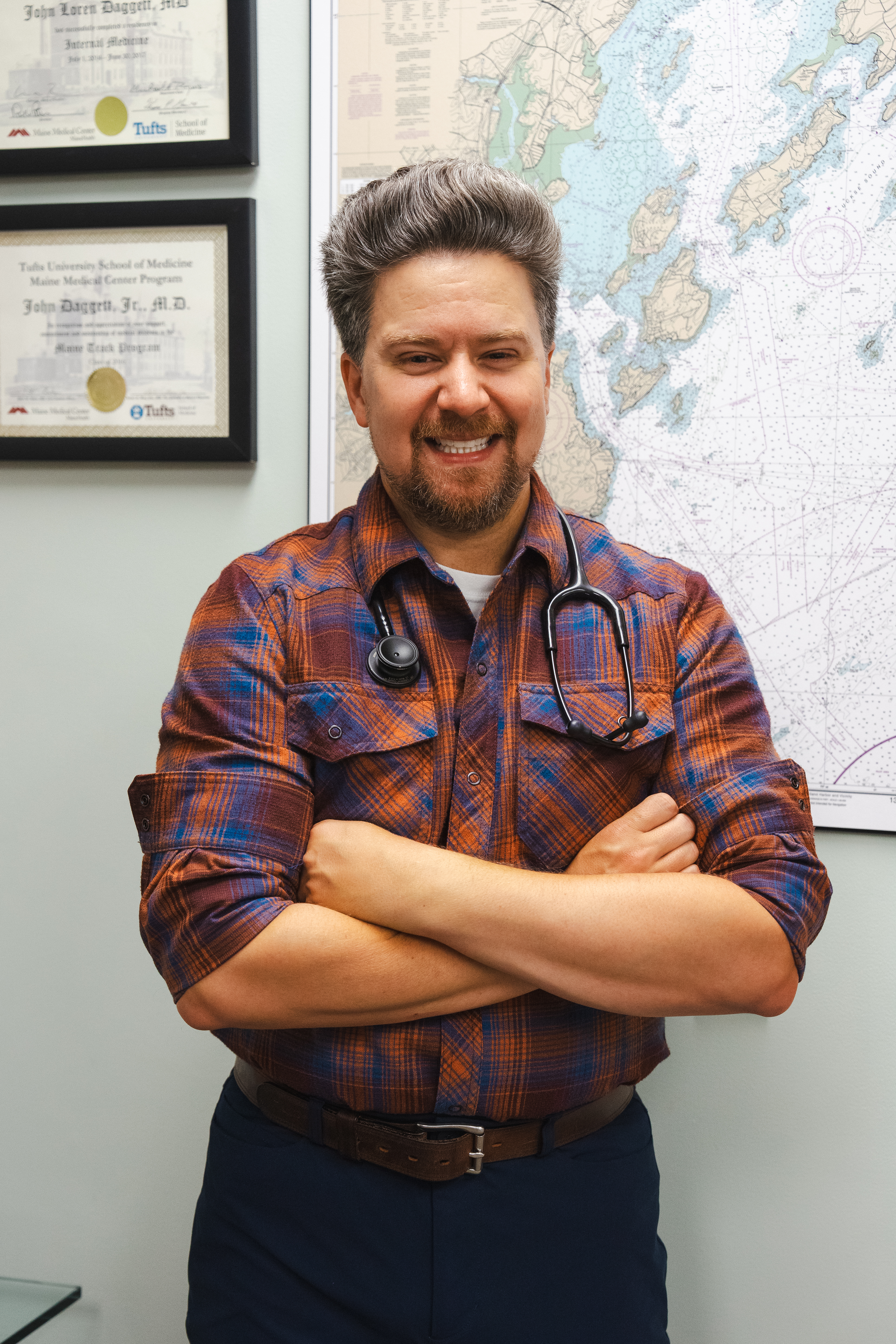
At his office in Yarmouth.
Once or twice a month, the doctor takes the ferry. From Yarmouth it's a short drive to the terminal, then out across Casco Bay to Long Island, Maine — a small year-round community of lobstermen, scallopers, and older residents, its population swelling each summer and thinning again by fall. On the island, John Daggett holds an open clinic. Patients walk down the road to see him; when they're done, they walk home. He'll see eight to fifteen people before the boat carries him back.
The arithmetic explains why he keeps coming. For a year-round islander, a routine appointment on the mainland is a day surrendered: the eight o'clock ferry for a ten o'clock visit, lunch in Portland, home by mid-afternoon if the schedule holds. "It really changes visiting the doctor," Daggett says. "It's kind of a day commitment." So he inverted it. The doctor makes the crossing; the patients keep their day.
He is quick to note that none of this would survive contact with the way he used to practice — twenty to thirty patients a day inside large health systems. "I don't think I ever could have made time for that in a different model," he says. The model he means is the one he built a year and a half ago in Yarmouth: a direct primary care practice — Yarmouth Direct Primary Care — one doctor, around 250 patients, $125 a month. What the membership buys, at bottom, is a physician with enough slack in his schedule to get on a boat.
The Band Kid
Daggett grew up in Litchfield, Maine, one of three brothers in a busy household — sports three seasons a year, school treated as a priority, and, looking back, a rural school system he credits with an outsized share of encouragement. "Even from a small town, it was a great group of teachers," he says.
But the thing that organized his youth was music. He joined beginner band in fifth grade, picked up the saxophone, and by high school had become, in his own telling, "a pretty intense band kid" — festivals, all-state, and a deepening obsession with jazz that took him all over the state. The plan was music education. He met his wife in high school band; she played trombone and came from a big family of music educators, and for a while they were both headed for the same career.
Then, in his junior year of high school, he shadowed his aunt — a nurse — through an emergency room shift. It was, he says, the classic version: busy, chaotic, everything happening at once. He walked out changed. "For some reason I left that shadowing thinking, oh my gosh, I think I've got to dive in here," he says. "This was amazing." He kept the music going — he still does — but the track switched to pre-med. "In hindsight, I certainly could have been doing music if I had missed that shadowing experience."
The first in his family to go to college, he chose Northeastern University in Boston, where the five-year co-op program put him inside Boston hospitals for months of real inpatient work while still an undergraduate. Medical school was Tufts, where he joined the second cohort of the Maine Track Program: roughly thirty students with ties to Maine, doing clinical rotations in the state and immersing in the workforce shortages squeezing rural health. "Even though we were in Boston, it was a very strong Maine feel," he says; many of those classmates remain friends. He came home for good with a residency in internal medicine at Maine Medical Center in Portland — three years during which his wife, by then a nurse, was working GI nursing in the same hospital. Two band kids, both landed in medicine, occasionally crossing paths on shift.
Grassroots
The first job came by way of family. His wife's grandparents kept an old chicken farm in Sangerville, a small rural town in the Dover-Foxcroft area, and on visits they'd point down the road: a nice little hospital, always looking for doctors. When residency ended, he went. His first position out of training was in a rural, underserved clinic in that corner of northern Maine — for a stretch, the only physician in the office.
It was grassroots primary care in the fullest sense. He saw his patients at the grocery store. He did house calls, because he knew which patients had mobility problems and which ones would simply never make it in. And he credits the small team in that office — a great medical assistant, a great nurse — with setting the pattern for everything since. "It really set me up to value the face time with patients," he says. He's still in touch with them.
Eventually southern Maine pulled the family back — friends, culture, the orbit of Portland — and Daggett went where most physicians go: what he calls "big box" primary care, working for large health systems. He even took a vice-president role in healthcare administration, testing whether that was the path. The test came back fast. "I quickly realized that I wanted to focus on caring for patients instead," he says. He calls the detour humbling, and worth it, and over.
Friends had already opened direct primary care practices, and they were in his ear with a simple pitch: do it, because you'll never look back. About a year and a half ago, he did — a one-doctor membership practice in Yarmouth, just north of Portland, announced with little more than a Facebook post. What happened next still delights him: patients he had cared for years earlier — some as far back as nine years — started calling. "They said, geez, we couldn't believe we heard you had your own practice — we're going to come see you," he says. Some are on his panel today. "For continuity, it's kind of the ultimate compliment."
Small by Design
The model is deliberately simple. Membership runs $125 a month — no insurance billing, no registration fee, no minimum commitment, ten percent off for paying a year up front. Daggett is careful to distinguish it from concierge medicine, where entry retainers can run $12,000 to $15,000. "It's accessible for a lot of people," he says. One patient did the math for him: "He said, geez — HBO is more expensive than your clinic."
What the fee buys, he says, is certainty about the one thing traditional primary care can't promise: who will be in the room. "I know when I go to the doctor, I know who I'm working with. I'm not going to be seen by another person. I know it's always going to be John." New patients can get a visit within three or four days, and intake visits are built to be unhurried — long enough to get everything on the table and start checking things off, instead of the rationing he watched for years in the traditional setting, where patients save up concerns and portion them out visit by visit.
The most unusual feature of the practice may be how you join it. Before nearly every enrollment, Daggett gets the prospective patient on the phone himself — to tell his story, hear theirs, and make sure the fit is real. The reaction, he says, is nearly universal bemusement: most people have never had a doctor call them before becoming a patient. But the call sets the terms of everything after — a practice small enough that the doctor answers.
It also makes for days that refuse to repeat themselves. He might see two patients in the morning, then drive to a house call. Not long ago, a mechanic he cares for injured his ring finger at the garage and couldn't leave work — so Daggett swung by the shop. "It's a combination of being here for people in a traditional sense," he says, "but then also getting out to my patients where they are."
The Turntable
The office itself sounds like him. A record player runs during the workday, and the vinyl on the shelves has become a two-way conversation: patients notice the albums, then start bringing their own. "I've had a lot of patients say, oh, I have a favorite album, I've got an extra copy, I'm going to bring it next time," he says. "It's kind of a universal language."
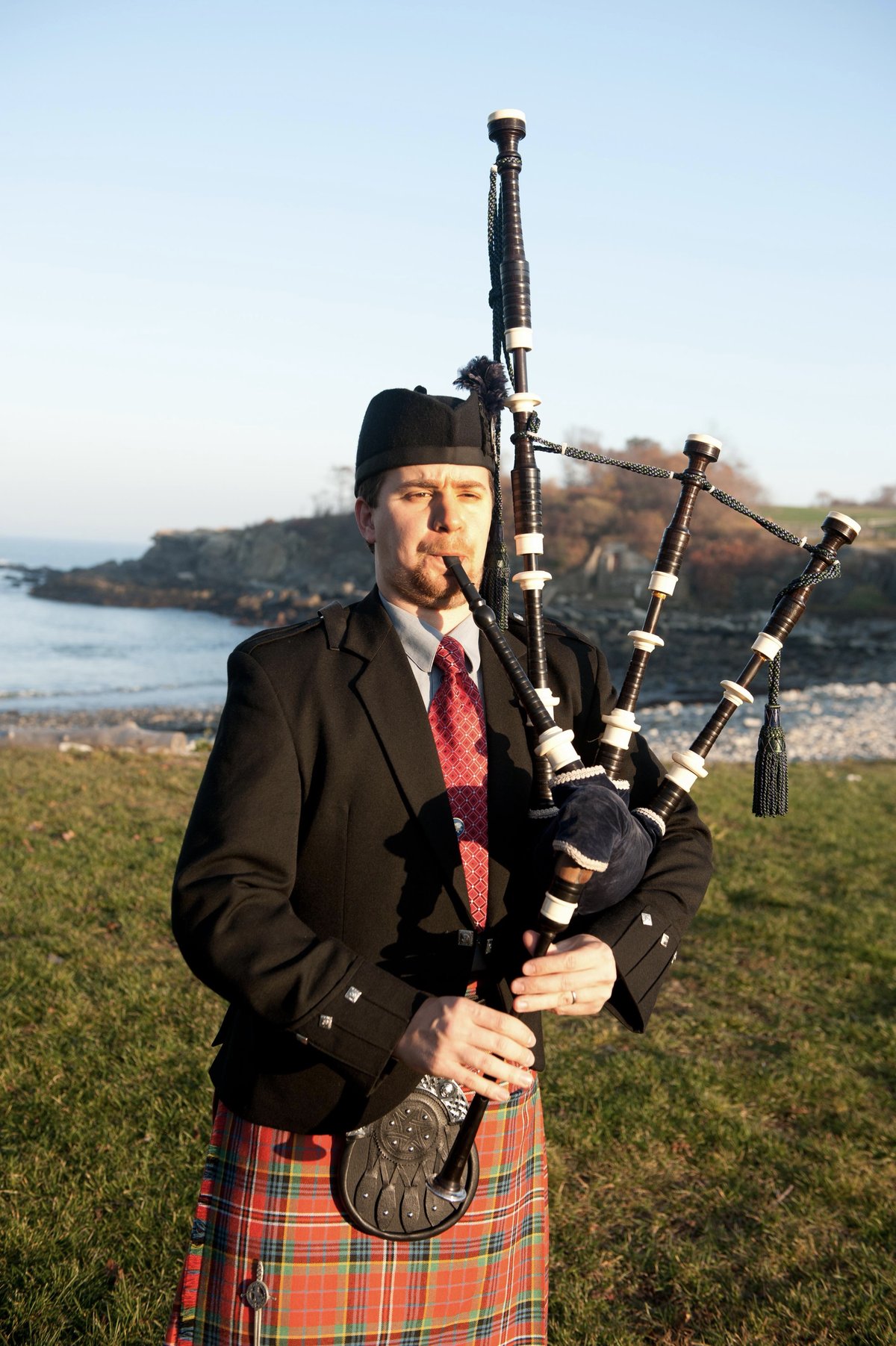
On the Maine coast. Daggett has played the bagpipes for twenty-three years.
Music, in fact, never left. Daggett has played the bagpipes for some twenty-three years — a freshman-year whim, sparked by a parade band, that his mother turned into lessons. In college he played outside Fenway Park after games with his case open, covering food and expenses one tune at a time. One night after a big Red Sox win, a fan stopped in front of him. "He just kind of stood there and looked at me," Daggett says, "and then he took off this authentic Ortiz jersey and draped it on my shoulders and walked away." He still has the jersey. He still plays, too — around five gigs a summer, mostly weddings, which the family converts into long weekends: a ceremony in Rangeley, then days of hiking before the drive home.
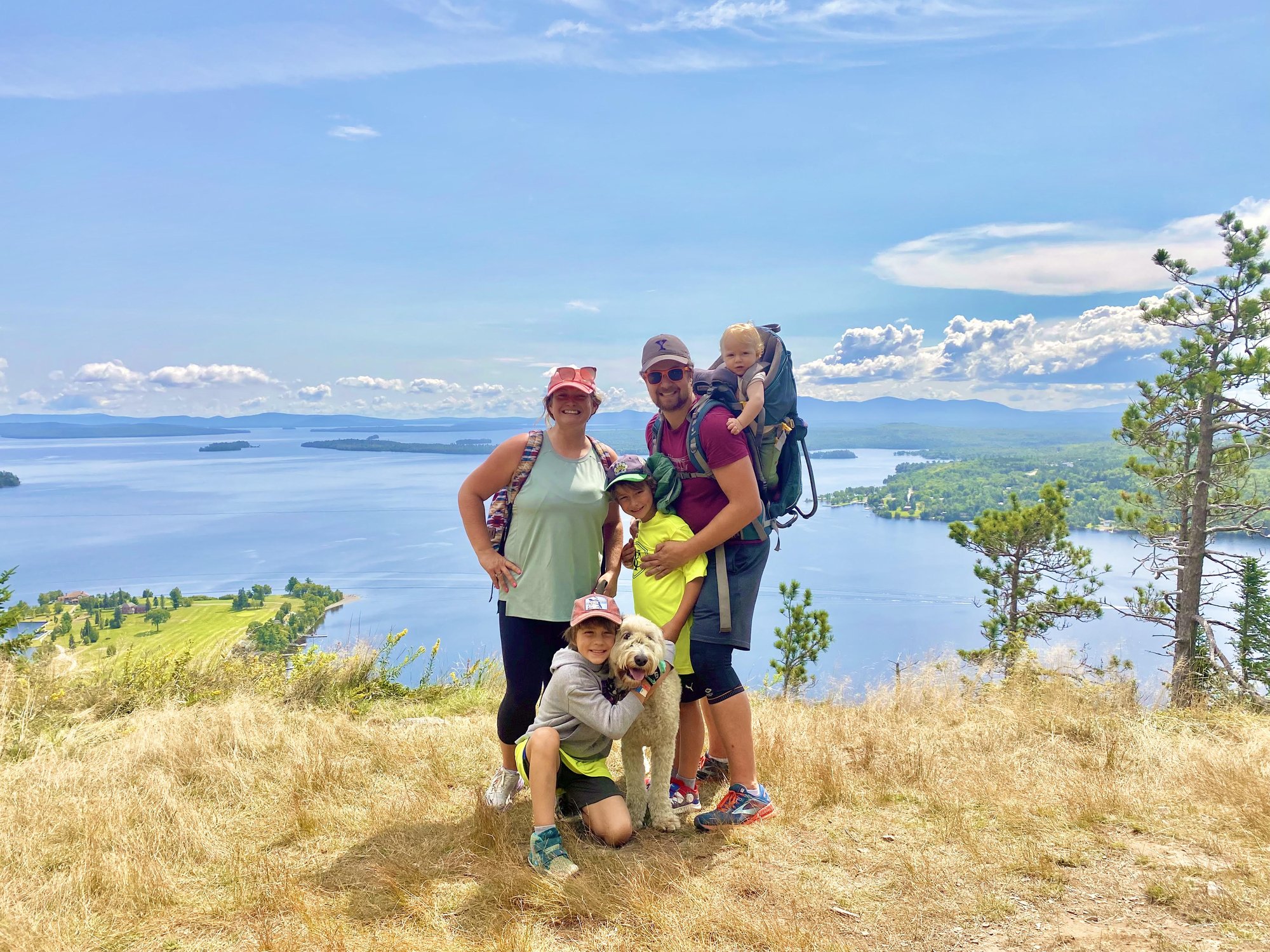
The Daggett family at the top of Mount Kineo, Moosehead Lake.
Family is the through-line he keeps returning to. He and his wife have three boys — ten and a half, nine, and two and a half — and both parents coach in Yarmouth: Little League just wrapped, summer baseball is next, basketball comes in winter. "You meet families so fast when you coach," he says. The boys are learning instruments — saxophone and trombone, their parents' horns — and the family calendar bends toward the arts: jazz sets in Boston and New York, Broadway shows, theater camp in the summer. He was the first in his family to go to college, and he names that, without hesitation, as the thing he most wants to get right. "Being a dad is the hardest job in my life," he says. "I learn a lot from my kids every day. If I can give them a leg up and set the stage for them to pursue what they love — that's definitely important."
Somewhere out in Casco Bay, the ferry keeps its schedule, and once or twice a month there's a doctor on it. It is a strange kind of throwback — the physician who calls you before you're his patient, sees you in days rather than months, turns up at your garage when you can't leave work, and crosses the water when you can't cross it yourself. Daggett has held the other jobs — the big systems, even the executive title — and chose this instead. Ask him what he hopes his patients say about him and the answer has nothing to do with titles: "Someone they could easily reach out to. Someone they could always talk to." On the island, they don't have to reach far. They just walk down the road.
Credentials
Independently verified · July 2026- Practice
- Yarmouth Direct Primary Care — direct primary care, internal medicine · Yarmouth, ME · founded January 2025
- Medical degree
- Tufts University School of Medicine, MD, 2014 · Maine Track Program, second cohort
- Residency
- Internal Medicine, Maine Medical Center, Portland, 2014–2017
- Board certification
- American Board of Internal Medicine
- State license
- Maine (MD21555) — active
- Undergraduate
- Northeastern University, BS in Biology · five-year co-op program
Verified by Vanguard Physician against primary sources, July 2026.