Dr. Oren Gersten, MD Family Medicine · Brunswick, ME
The Doctor His Patients Know Best
Oren Gersten grew up answering to wildlife biologists at the dinner table and learned to fly-fish on the Yellowstone. Now he runs a one-doctor practice on Maine Street in Brunswick — where visits last an hour, and the doctor who calls with your results is the one who ordered them.
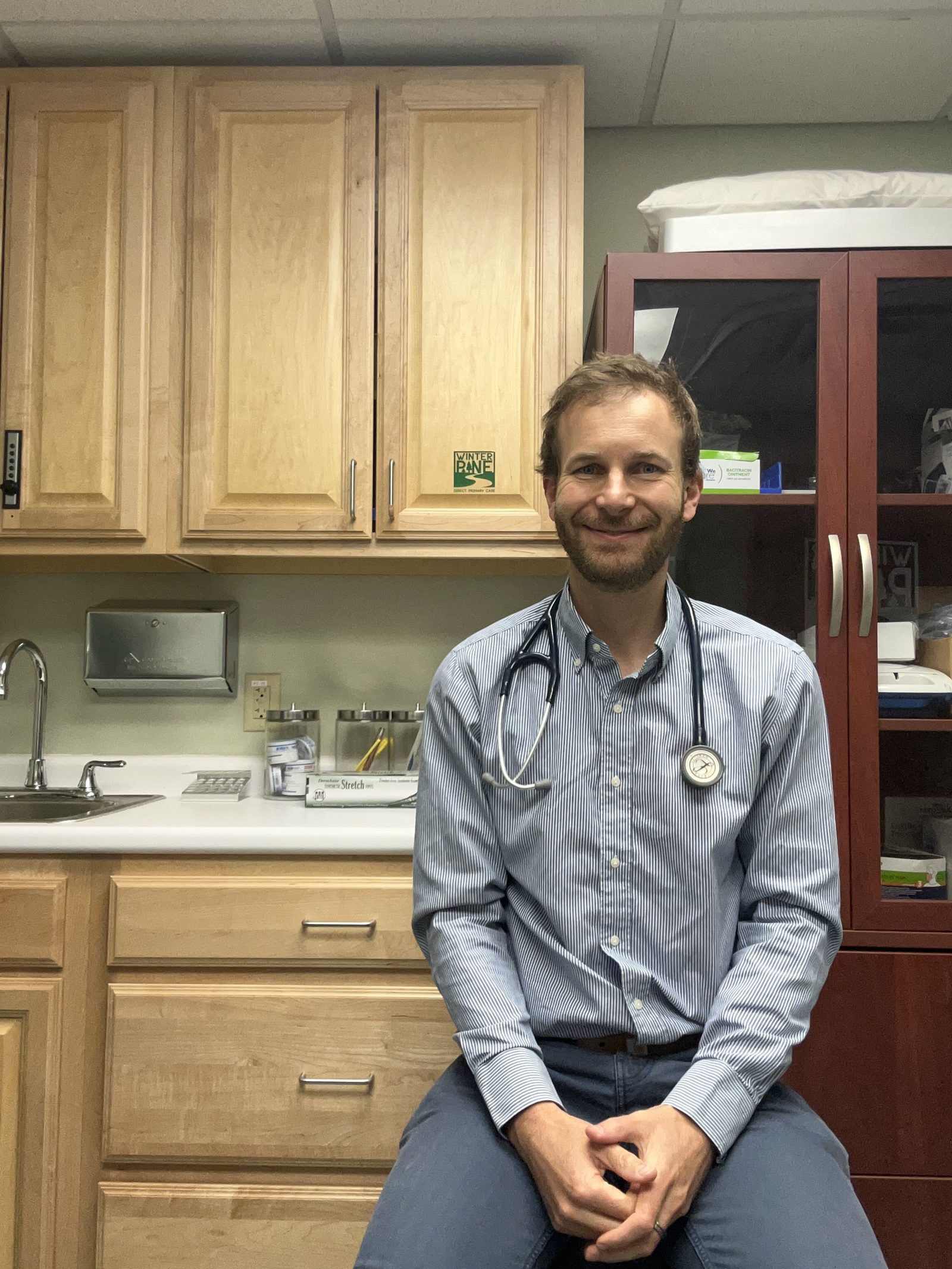
At his exam room in Brunswick.
The medicine was three miles down the mountain, locked in a truck at the trailhead, and the boy who needed it was in a tent at the top. It was around nine at night. Oren Gersten was a medical student then, on an elective at a residential psychiatric program for children — kids whose diagnoses had pulled them out of traditional classrooms and into a life of careful routine. Once a year, the program's psychiatrist broke that routine on purpose: he marched his young patients up a mountain to camp overnight, on the theory that the hardest thing some of them had ever done might also be the best. The staff had spent days organizing every child's medication for the trip. One bottle — the one a student could not safely go a night without — never made it out of the vehicle.
So Gersten and another staff member ran. Three miles down in the dark, three miles back up, and the medication reached the boy in time. Gersten had been a wilderness guide before medical school; the psychiatrist had waved him onto the trip precisely because he knew his way around a mountain at night. When Gersten tells the story now, he doesn't tell it as heroics. He tells it as the moment the two halves of his life clicked together — the medicine and the mountains, the chart and the trail — into a single idea about what the job is: you go get what the patient needs, yourself, even when it's dark and the trail runs the wrong way.
Two decades on, in a suite at 331 Maine Street in Brunswick, that idea persists in quieter form. When a lab result comes back for one of his patients, it is Dr. Oren — not a nurse, not a portal notification — who picks up the phone.
The Background
Gersten was raised in mountain towns in Montana and Wyoming, in a family where the life sciences weren't a subject so much as the weather. His mother and stepfather were wildlife biologists in Yellowstone National Park; dinner conversation ran to coyotes, wolves, and grizzlies. His father, a cinematographer, disappeared on shoots to film orangutans in Borneo and polar bears in the Arctic. School handed out ski passes for good grades, so he spent most winter weekends on world-class terrain and assumed, for years, that this was what normal looked like. His grandmother, an avid fly-fisher, took him out on the Yellowstone River and taught him to read water. "She just really inspired a love for the outdoors with me," he says — an anchor, as he puts it, through everything that followed.
Medicine was not the plan. At Wesleyan University he drifted between biology and engineering until a junior-year course called Drugs and Disease — how people get sick, how they can be treated — caught him in a way nothing else had. The MCAT went well. The door was open. He walked through it to the University of Washington School of Medicine, whose five-state WWAMI program let him train back in his home region — including, between his first and second years, a two-month immersion on the Blackfeet Reservation in Browning, Montana, where he had an apartment next door to Dr. Mary Desrosier, a family physician who did all of it: deliveries, hospital rounds, clinic. He remembers a complicated delivery and Desrosier's total calm through it. "She was unflappable," he says. "It seemed like she always knew what to do." She was also, he noticed, practicing in a way that was true to her own roots — proof that a well-trained family doctor could be a whole person and a whole physician at once.
The other mentor was the psychiatrist from the mountain — Dr. Mick Storck. What stuck wasn't the camping trip. It was the way the man opened every encounter: asking about the family, about life outside the walls, before ever getting to the chart. Some people call that the human side of medicine. Gersten simply took it as the instruction manual.
The Pivot
He chose Maine Medical Center in Portland for family medicine residency, 2015 to 2018, and did what residents do: disappeared into it. Toward the end, when the question of a job finally surfaced, he looked at the postings — twenty patients a day, an hour or two of charting after clinic — and then he looked at the physicians five and ten years ahead of him in those jobs. Nobody was giving rave reviews. "There's got to be another option," he remembers thinking.
First, though, the trip. He and his wife drove from Maine to Colorado and hiked a hundred miles of the Continental Divide Trail with their dog, fully unplugged. The other option, when it arrived, came by coincidence: at a film screening, he met a physician who had opened her own direct primary care practice — a model that skips insurance billing entirely and charges patients a flat membership fee for all of their primary care. She didn't explain it; she showed him. He spent a day in her clinic. The patients seemed happy. She seemed happy. At lunch, she went paddleboarding. "I didn't even know that was possible as a physician," he says.
He opened his own practice in the Portland area in 2018, straight out of residency, and gave himself a year to see if it could survive. "I earned every single patient in my practice," he says — each one arriving by referral or by looking him up and deciding, after a conversation, that this was their doctor. The model shaped itself around what those patients kept asking for: hour-long standard visits instead of ten minutes; several touchpoints a year instead of an annual physical; results delivered by the doctor who ordered them. "Seven and a half years later, I can't imagine doing anything else," he says. "I can't imagine working for anybody else."
This year he moved the practice up the coast to Brunswick and gave it a new name. On his office wall hangs a large canvas print — a snowy ridgeline near the treeline in British Columbia, heavy pines under fresh snow, from a ski trip with old friends. "That's just my happy place," he says. "It's where I feel most like myself." Winter pine, in the Pine Tree State. A patient of his, a graphic designer, drew the logo.
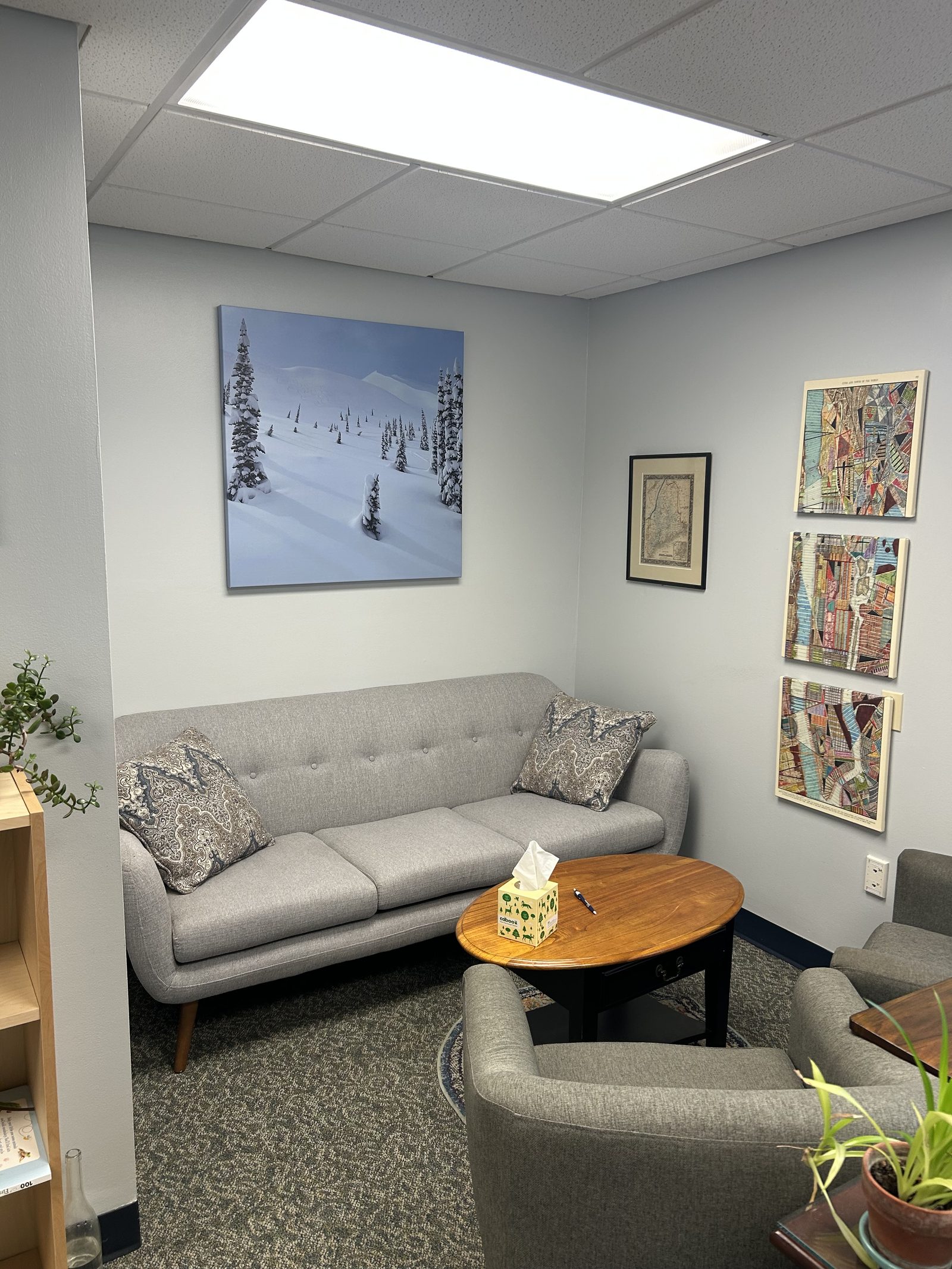
The canvas that named the practice: snow-covered pines near the treeline in British Columbia, from a ski trip with friends. It hangs where he can see it from his desk.
The Practice
Membership at Winter Pine runs $100 a month — capped at $250 for a family — and covers the primary care itself: the physicals, the sick visits, the stitches, the chronic-disease management, the phone calls. The structural point, as Dr. Oren explains it, is what the flat fee removes. He isn't paid per encounter, so there is no arithmetic pushing him to over-schedule, no surprise bill waiting behind a visit, and no penalty — for him or for the patient — when life gets in the way of an appointment. The pressure that the fee-for-service system quietly applies to both sides of the exam table simply isn't in the room.
The patients he believes he helps most are the ones the system has already lost. Twenty- and thirty-somethings who left their pediatrician years ago and never landed anywhere — healthy until they weren't — get what he calls a soft landing into primary care. And patients in their forties and fifties arrive carrying the scar tissue of an outrageous bill or a decade of depersonalized chronic-disease care, having concluded the whole enterprise wasn't built for them. "Re-engaging those people where we've lost their trust" is how he describes the work — less a marketing position than a running theme of his week. It helps that the practice has a personality. The outdoorsy doctor draws outdoorsy patients: mountain bikers who talk shop about their rigs, professional skiers, and the merely curious, who leave with trail recommendations alongside their care plan.
Patients tell him, with some regularity, that he's the best doctor they've ever had. He refuses to accept it — and his reasoning is the most quietly damning thing he says about American medicine. "I think it speaks more to how far our system has fallen than to how good of a doctor I am," he says. "If all I have to do to impress people is answer my phone, that's a pretty low bar." The compliment he will accept is narrower and, he thinks, truer: "I'm the doctor that my patients have gotten to know the best."
The knowing runs both ways. Dr. Oren is a father of two — a one-year-old and a four-year-old — and the night before this interview, he finished a full clinic day and still made it to his son's swim lesson at Bowdoin College, where a college athlete has spent the summer turning a boy who once aspirated pool water in terror into a kid who jumps in wearing goggles. Over the July Fourth holiday he closed the clinic, kept a colleague on call for emergencies, and spent three whole days watching his daughter toddle after watermelon. He is careful not to oversell it. "I haven't hacked the system," he says. There are still things he misses. But the balance that most physicians describe the way sailors describe mermaids, he has actually seen — and built a practice where it lives.
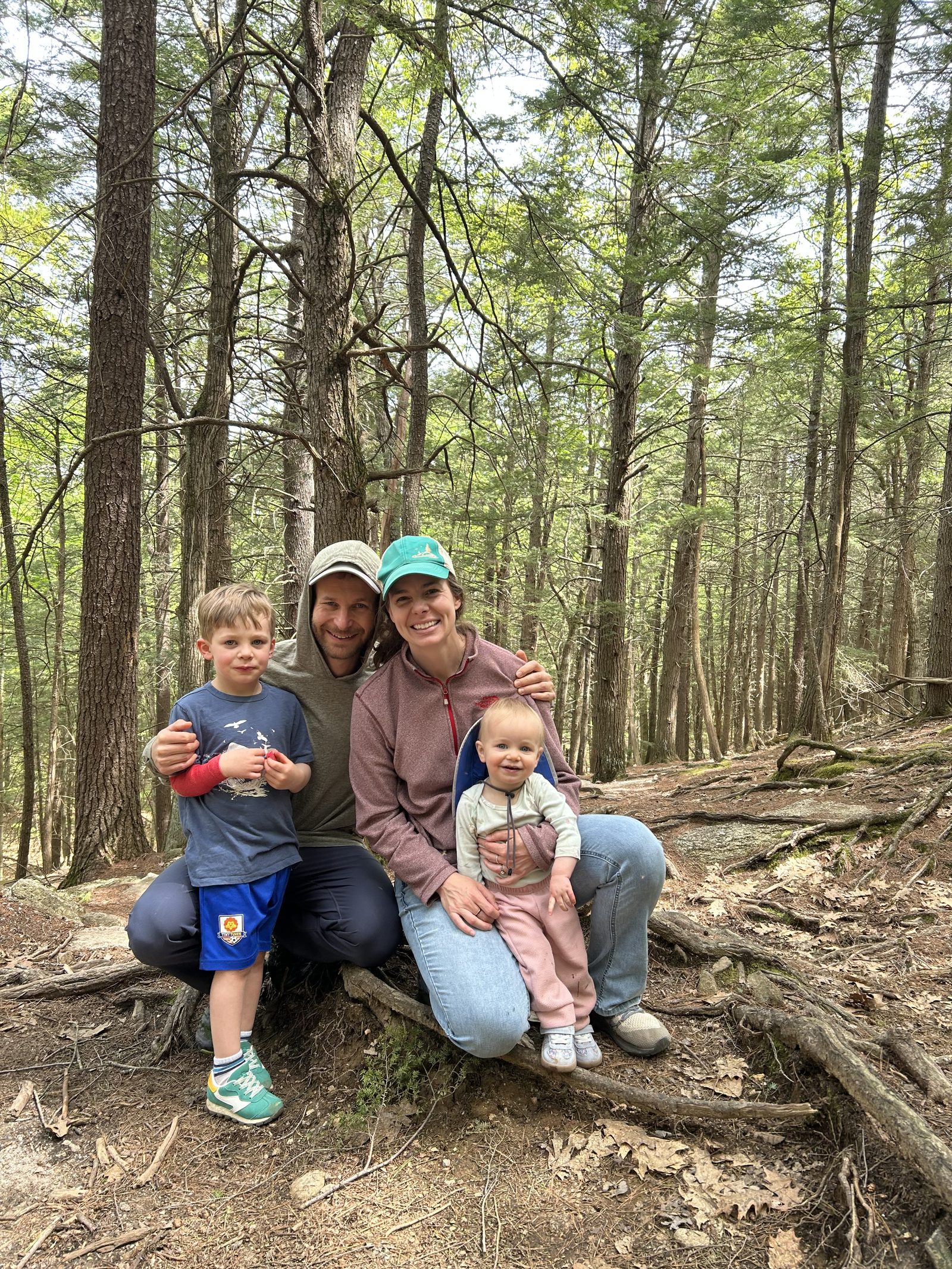
The family among the pines — the landscape that shaped the doctor and named the practice.
Somewhere on that office wall, the British Columbia pines keep their snow year-round. Dr. Oren named the practice after the place where he feels most like himself. Then he spent seven and a half years building the kind of practice where his patients could say the same — and if something they need ever ends up three miles down the mountain, they know exactly who is going to run and get it.
Credentials
Independently verified · July 2026- Practice
- Winter Pine Direct Primary Care — direct primary care, family medicine · 331 Maine St., Ste. 6, Brunswick, ME · founded 2018 (as Portland Direct Primary Care), relocated and renamed 2026
- Medical degree
- University of Washington School of Medicine, MD (2015)
- Residency
- Family Medicine, Maine Medical Center, Portland (2015–2018) · 200-hour Integrative Medicine in Residency curriculum
- Board certification
- American Board of Family Medicine — board certified
- State license
- Maine, MD22136 — active
- Undergraduate
- Wesleyan University, BA Biology (2008)
Verified by Vanguard Physician against primary sources, July 2026.