Dr. Leigh LoPresti, MD Family Medicine · Manchester Center, VT
To Comfort Always
He announced his future at four and wrote out the timeline in a fourth-grade notebook. Forty years of medicine later, Leigh LoPresti came back to Manchester to keep the promise the way he always meant to.
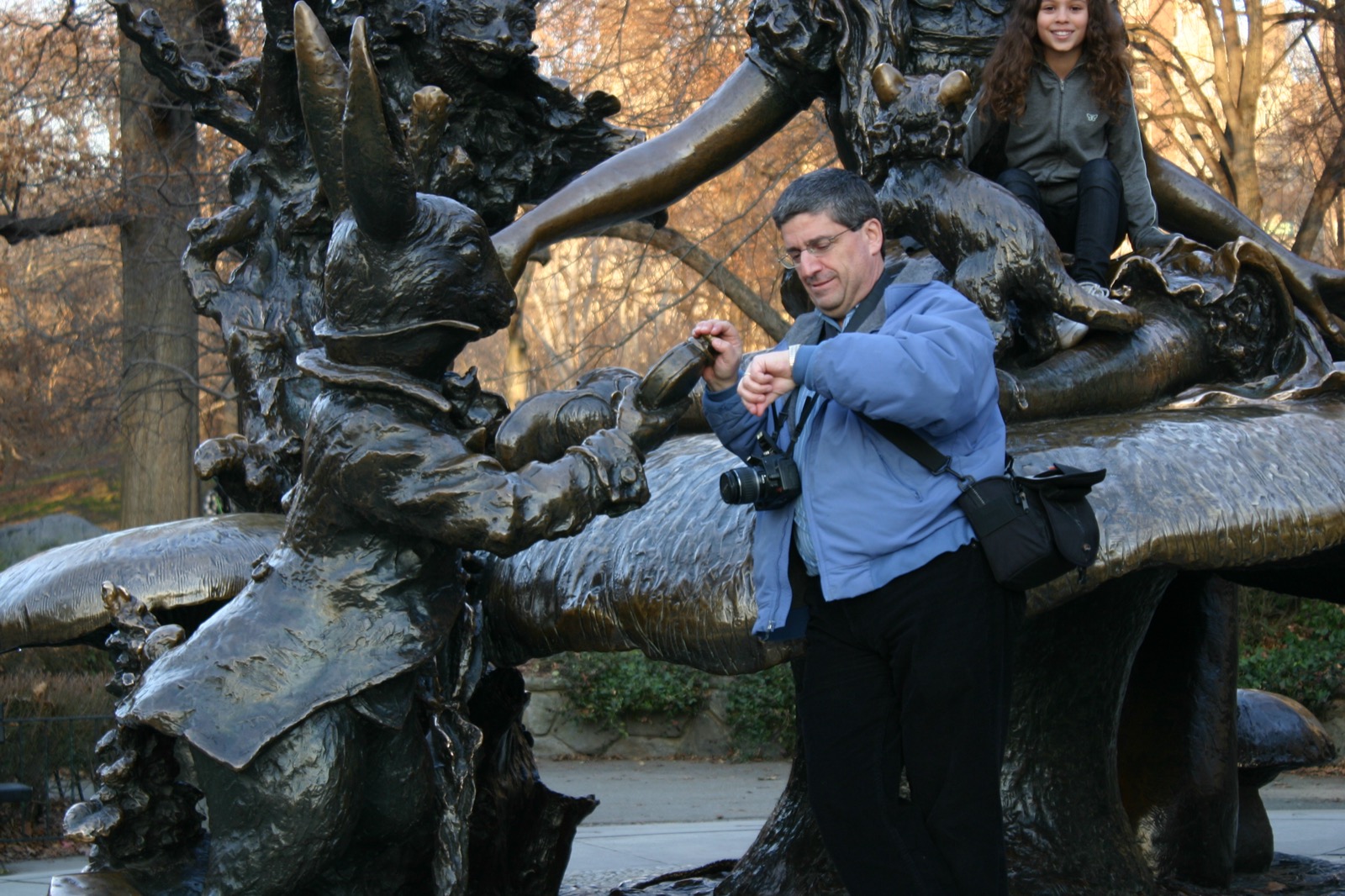
Checking to see if the White Rabbit really was late — at the Alice in Wonderland statue in Central Park.
On a January evening in 1981, a medical student paced the basement of his school's library, fairly sure he had chosen the wrong life. That day, on his first clinical rotation, a patient had turned up with a urinary tract infection — one of the most ordinary problems in all of medicine — and Leigh LoPresti had not known what to do. "Treat it," the resident told him. How? "Look it up." He looked it up, wrote a plan, and got the dose wrong. A year and a half of basic science in his head, and no idea, apparently, how to take care of an actual person.
The library kept its old journals in open stacks on the bottom floor. Pacing among them, LoPresti had what he describes as one of the few six-sense moments of his life: something told him to look up and to his left. He did. On the shelf above him sat the 1881 run of the British Medical Journal — one hundred years old, nearly to the month. He pulled down the January volume. In its front pages, the editors had convened five distinguished scientists to weigh in on a controversial new theory. Three thought the theory was rubbish. One endorsed it. One declined to judge for lack of evidence. The theory in question was whether germs cause disease.
He walked out of the library feeling, for the first time that day, that he knew something. About halfway home he stopped on the sidewalk. "They're going to be laughing at us in a hundred years," he said aloud, "aren't they?"
Forty-five years later, that evening is still the load-bearing wall of how LoPresti practices: certainty is provisional, and humility is not a virtue so much as an operating requirement. A strange creed for a man whose own path never wavered — because the other thing to know about Leigh LoPresti is that he has known exactly what he was going to do since he was four years old.
The Notebook
LoPresti grew up in Suffolk County, Long Island — forty-five miles from the Midtown Tunnel, a figure he can cite because his odometer read the same thing every trip into Manhattan. It was a nuclear household: father, mother, an older brother who would become a dentist, a younger sister. He was, by his own affectionate account, a pain in the ass — the kid who got it the first time and spent the rest of the class bored.
The family story is that he came home from an appointment with the family doctor and informed his mother he was going to be one. He was four. Decades later, cleaning out his mother's home, he found his fourth-grade notebook. Written in the back, in a nine-year-old's hand, were the years he would finish college, finish medical school, finish internship, and finish residency.
The plan survived contact with adolescence. High school biology arrived like a homecoming — "the course I've been waiting for," he remembers thinking — and fused with the other pole of his childhood, a habit of service that ran through Boy Scouts and the Key Club. Science plus serving people: the arithmetic pointed one direction. At Amherst College he ran the pre-med gauntlet, twelve science courses with labs, and wrestled for two years until a New York state champion ahead of him on the depth chart ended that career. The rest went according to the notebook.
A Doctor for Whole Families
At the University of Vermont College of Medicine, LoPresti auditioned the specialties the way a skeptic should. Cardiology collapsed under a single observation: nearly every patient he saw was a sixty-year-old man who had just quit smoking after his heart attack, and he could not picture thirty years of that conversation. Obstetrics fell when he discovered how much of it was surgery, and surgery had already fallen when he discovered he did not like touching organs. Pathology, he concluded, was boring. What remained was the inventory of everything he had actually liked — internal medicine, pediatrics, psychiatry, obstetrics minus the operating room — and one question: how do you do all of it?
The answer was family medicine, and a two-month rotation sealed it. He kept seeing patients, and then their kids, and then their husbands. They were serious about the family part. In that first Manchester practice, he had two four-generation families on his panel — kids to great-grandparents, all under his care. He never looked back.
At his graduation, after a weekend of being called Dr. LoPresti by everyone he loved, he pulled aside his brother — the dentist — and asked when you get used to being called "doctor." His brother considered him for a long moment before answering.

With his wife at Niagara Falls.
He trained in Vermont and stayed, and in 1991 he became a family doctor in Manchester — small-town medicine in the fullest sense, whole households on his panel, and deliveries too: across his career, LoPresti delivered babies for twenty-four years. He practiced in Manchester for a decade and loved it, and might never have left, except that a promise someone else had made about him came due.
"You're Ready"
In medical school, LoPresti had a mentor — John, a family doctor who practiced for years at the base of Sugarbush Mountain and could reduce any fracture and make it look easy — who kept telling him he was going to teach. LoPresti kept declining the prophecy: he had no special skill like John's worth passing on. Around 2000 they crossed paths at a conference. John looked at him and said, "You're ready." LoPresti protested that he wasn't going to teach and didn't even know how one got into the field. "You're ready," John said. "We're ending that conversation." Two months later, unbidden, an invitation arrived from a residency program.
LoPresti, a man who likes to pay things forward, took it as a verdict. He spent roughly a decade teaching residents and medical students at Eastern Maine Medical Center and the Medical College of Wisconsin, where he also completed a research fellowship. Teaching made him a better doctor for the simplest of reasons: residents ask hard questions, and you either have the answers or you go find them. He published nine papers; his favorite, written with a medical student, reconstructs a real conversation between the two of them about what actually heals people. But he missed being somebody's doctor.
Fifteen Minutes
Most doctors who sour on the system watch it decline around them, year by year. LoPresti had a stranger vantage: he stepped out of full-time practice in 2001, and by the time he stepped back in, the profession had been remodeled in his absence. Every patient now got fifteen minutes — not the patients whose problems warranted fifteen minutes; every patient, whatever the problem. In the Manchester practice he'd left, he had spent forty-five minutes with the people who needed forty-five. Now the schedule was set for him, not for the patients. He is, in that sense, a before-and-after witness — he isn't guessing at what was lost, because he practiced on both sides of it.
One scene from those years stands in for the rest. An administrator — LoPresti won't say where — reviewed his charts and had a suggestion: LoPresti was managing a diabetic patient's blood pressure and cholesterol in the same visit as the diabetes, and really, that should be three separate visits — three billable appointments instead of one. LoPresti asked whether the man was familiar with the standard of care for diabetes, which requires managing all of a patient's cardiac risk factors together. What was he supposed to do in the other two visits — say the same things about the same medicines? Patients wouldn't stand for it. "Just keep repeating yourself," the administrator said. LoPresti declined.
He burned out — completely, in his word. The pull toward the exit had a voice, and it belonged to Jill, one of the brightest residents he ever trained, who had built a direct primary care practice of her own and spent years calling her old teacher. Leigh, you need to do this. His answer, for years: Jill, I'm too old to do that. What changed his mind, in the end, was the conclusion that the system was not going to get better — and the realization that there was still a way to take care of patients the way he'd always meant to. Doing it the right way. Taking the time.
Doing It the Right Way
On April 15, 2024, Manchester Direct Family Practice opened at 32 Center Hill Road in Manchester Center — the same community LoPresti had left twenty-three years earlier. The practice runs on the direct primary care model: patients pay a flat membership fee, insurance never enters the exam room, and visits last as long as the problem requires. There is no staff. LoPresti answers the phone. LoPresti draws the blood. LoPresti is the person who calls you back.
The dividends arrive in a currency he had almost forgotten existed. Within two months of opening, six patients had told him — unprompted, in emails and texts — I really appreciate you. He rarely heard those words in the old system. Now he hears them regularly, from people he actually knows — not fairly-well-after-ten-visits knows, but knows.
Ask LoPresti what he's actually trying to build and he reaches past the model to two sentences. The first comes from a 1927 address to the graduating class of Harvard Medical School, and he supplies the translation the century requires: the secret of patient care is caring for the patient — where "caring for," in the idiom of 1927, meant caring about. The second is a nine-word definition of doctoring whose author he has hunted for years without success: to cure sometimes, to relieve often, to comfort always. Those two sentences, he says, are the whole motivation. Everything else is logistics.
Mama Bear
LoPresti's wife died in 2019. She went into surgery at eight in the evening and came out around midnight; she died in the ICU at five in the morning. Their younger daughter had just finished her junior year of high school; he and his wife had been talking, happily, about the empty-nest years ahead. Among the things they had finished together was a project begun in 2004: getting their two girls to all fifty states. They completed it in 2017, and he names it, without hesitation, as one of the achievements of his life — though he notes, with a widower's arithmetic, that it may explain why his daughters are so comfortable living far away. One is a genetic counselor in Milwaukee, twenty-eight and already a known voice in her field; the other, twenty-four, produces film in Los Angeles.
That evening, fourteen hours after they had lost her, LoPresti drove to the Albany airport with his older daughter to pick up her boyfriend — his plane was landing at nine, and neither of them trusted the other to drive alone in the dark. His younger daughter stayed at the house. She texted them from the raised deck: Dad, there's a bear in the yard.
He wrote back: Mama bear? — meaning cubs, meaning be careful.
No cubs, she answered. The bear was fifty feet from the deck. Then, a while later: it had sat down and simply looked at her for ten minutes. It made a small sound. It turned around and walked away.
In the years LoPresti has lived on that land, the bear had never once come out of the woods before that night, and he has never seen it since — he hears it sometimes, off in the trees. The family does not argue about what it was. They call it mama bear.

The LoPresti family on a glacier in Alaska — one stop in a project begun in 2004 to visit all fifty states together. They finished in 2017.
The View from the Deck
Home is eleven acres with a thirty-five-mile view of the mountains, quiet enough that the only sound from the deck is birdsong. Deer and turkeys graze the yard; foxes pass through; for about five years a bobcat kept residence at the wood line. His current project is the national parks — thirty-three down, out of sixty-three, with Indiana Dunes on the list mostly because he cannot figure out what's special about a bunch of dunes on Lake Michigan and intends to find out.
And lately, he photographs the sky. It started with a bucket-list item, the Northern Lights, and escalated when totality crossed Vermont — April 8, 2024, one week before his practice opened. He drove to a spot he'd scouted and shot the eclipse; in the frame, when he looked later, was a solar flare. His camera had picked it up from ninety-three million miles away. He has moved on to the Milky Way and is now working out how to capture Andromeda — a family doctor in his front yard, aiming a lens at a galaxy.

Totality in Vermont, April 8, 2024 — one week before the practice opened. The solar flare is visible at the lower left of the corona.
Forty years on, he hands his brother's advice to the medical students who pass through his exam rooms, along with the rest of the inheritance: you will never know everything; you will make mistakes; do your best anyway. It is the creed of a man who was told, once, in a library basement, to look up — and who, with a camera pointed at Andromeda, still does.
Credentials
Independently verified · July 2026- Practice
- Manchester Direct Family Practice — direct primary care, family medicine · 32 Center Hill Road, Manchester Center, VT · founded April 2024
- Medical degree
- University of Vermont College of Medicine, MD (1983)
- Residency
- Family Medicine, University of Vermont / Medical Center Hospital of Vermont (completed 1986)
- Board certification
- American Board of Family Medicine — continuously certified since 1986
- Academic appointments
- Faculty, Eastern Maine Medical Center; Medical College of Wisconsin (residency teaching and research fellowship), 2001–2010
- Publications
- Nine peer-reviewed papers, including "Affect and the Art of Healing," Family Medicine, 2009
- State license
- Vermont, #0420007260 — active
Verified by Vanguard Physician against primary sources, July 2026.